
Can you afford a personal loan simply because a bank is willing to approve it?
Not necessarily. A lender’s approval assessment and your personal financial circumstances answer different questions.
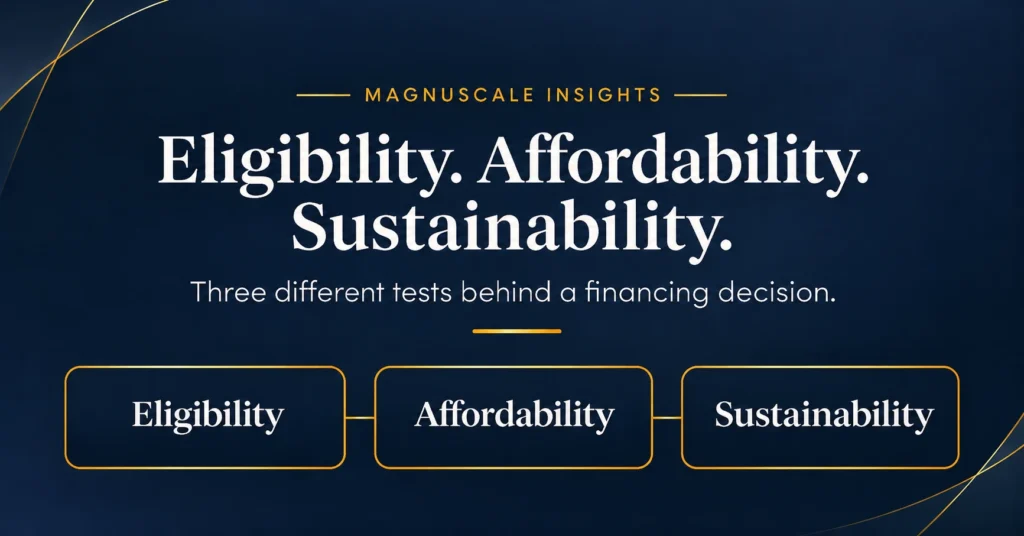
Before accepting new financing, it is important to understand three separate concepts: eligibility, affordability and financial sustainability.
1. Loan Eligibility: Can You Qualify?
Loan eligibility refers to whether a borrower meets a lender’s financing criteria.
A lender may examine factors such as income, existing financial commitments, credit history, repayment behaviour and its internal credit policies.
One commonly used assessment is the Debt Service Ratio (DSR), which compares monthly debt repayments against income.
However, different lenders may apply different income definitions, assessment methods and acceptance criteria.
The important distinction: Meeting a lender’s eligibility requirements does not automatically mean that the proposed financing is suitable for your personal circumstances.
2. Loan Affordability: Can Your Monthly Budget Support It?
Affordability considers whether you can manage the proposed repayment while continuing to meet your living expenses and other financial obligations.
Unlike a DSR calculation focused on debt commitments, a personal affordability review considers the wider household budget.
This may include housing, groceries, transport, insurance, family support, healthcare and other recurring expenses.
A repayment may appear manageable when examined against income alone, but create pressure once these other commitments are considered.
3. Financial Sustainability: Can You Maintain It Over Time?
Financial sustainability goes beyond the ability to make next month’s repayment.
It considers whether your financial position can withstand unexpected events without repeatedly relying on credit or sacrificing essential commitments.
Relevant considerations include emergency savings, income stability, dependants, upcoming expenses and the ability to continue saving.
A financing decision may be affordable under current conditions but financially fragile if even a modest disruption creates repayment difficulties.
4. A Malaysian Borrower’s Example
Consider a hypothetical salaried employee evaluating a new personal loan.
| Financial information | Monthly amount |
|---|---|
| Gross salary | RM6,000 |
| Net take-home income | RM5,100 |
| Existing debt repayments | RM1,500 |
| Proposed new loan repayment | RM900 |
| Essential living expenses | RM2,200 |
| Discretionary expenses | RM300 |
| Current emergency savings | RM4,000 |
The example is simplified for educational purposes. Actual household finances and lender assessments may include additional items.
Test 1: Eligibility
Assume, purely for illustration, that the lender assesses DSR using gross salary and a maximum threshold of 60%.
Total debt repayments after the new loan:
RM1,500 + RM900 = RM2,400
Illustrative DSR:
RM2,400 ÷ RM6,000 × 100 = 40%
Under the assumed 60% threshold, this particular DSR measure falls below the limit.
However, that does not establish actual eligibility or guarantee approval. A lender may apply a different income basis, additional obligations or other credit criteria.
Test 2: Affordability
Now examine the borrower’s actual monthly cash flow.
| Cash-flow calculation | Amount |
|---|---|
| Net take-home income | RM5,100 |
| Less: Existing debt repayments | −RM1,500 |
| Less: Proposed new repayment | −RM900 |
| Less: Essential living expenses | −RM2,200 |
| Less: Discretionary expenses | −RM300 |
| Remaining monthly cash flow | RM200 |
After accounting for these expenses, the borrower has only RM200 remaining each month.
That is approximately 3.9% of net income.
The borrower may be able to make the repayment under the assumptions presented, but the limited surplus leaves little room for irregular expenses, additional savings or changes in circumstances.
Test 3: Financial Sustainability
Assume the borrower has RM4,000 in accessible emergency savings.
Essential monthly outgoings after the proposed financing comprise:
- Existing debt repayments: RM1,500
- New loan repayment: RM900
- Essential living expenses: RM2,200
Total: RM4,600 per month
Emergency-fund coverage:
RM4,000 ÷ RM4,600 = 0.87 months
In this example, emergency savings would cover less than one month of the identified essential outgoings, assuming spending remained at those levels.
This indicates limited financial resilience. An income interruption, major repair or unexpected medical expense could put additional pressure on the borrower’s ability to maintain repayments.
A common financial-planning starting point is an emergency reserve covering three to six months of essential expenditure, adjusted for individual circumstances.
5. What Does This Example Tell Us?
The three assessments provide different insights.
| Assessment | Illustrative finding |
|---|---|
| Eligibility | The assumed gross-income DSR test is satisfied; actual approval remains uncertain |
| Affordability | The budget has a positive but narrow RM200 monthly surplus |
| Sustainability | Emergency savings cover approximately 0.87 months of essential outgoings |
The borrower has not necessarily made a poor financing decision merely because the savings buffer is limited.
The purpose of the analysis is to identify financial trade-offs before the borrower commits.
For example, the borrower might reconsider the financing amount, delay borrowing while building savings, adjust discretionary expenditure or investigate alternatives that achieve the underlying financial objective with less repayment pressure.
6. Questions to Ask Before Accepting Financing
Before making a final decision, consider the following:
- What is the purpose of the financing, and is the full amount necessary?
- How much monthly cash flow will remain after the new repayment and ordinary living expenses?
- Are there annual, irregular or upcoming expenses that have not been included?
- How much emergency savings will remain after any upfront financing-related costs?
- Could the household maintain its essential commitments during a temporary loss of income?
- What is the total borrowing cost, and how does the repayment commitment affect other financial goals?
These questions help move the discussion beyond approval alone.
7. The Better Financing Decision
Eligibility does not mean affordability. Affordability does not necessarily mean sustainability.
Eligibility helps establish whether financing may be available.
Affordability examines whether the repayment fits your present financial circumstances.
Sustainability considers whether that decision remains manageable when circumstances change.
A responsible financing decision considers all three before commitment.
At Magnuscale, our approach is to review financing capacity, personal affordability and financial sustainability together, helping clients understand the broader implications of taking on new financing. Learn more about our Personal Financing Review.
For more practical perspectives on borrowing decisions, explore our Magnuscale Insights articles covering personal financing, credit readiness and financial sustainability.
References and Further Reading
The following resources provide additional information on debt service ratios, financial resilience and emergency savings in Malaysia.
- Perbadanan Insurans Deposit Malaysia (PIDM) — What Is Debt Service Ratio? An explanation of DSR, financing eligibility and affordability.
- Bank Negara Malaysia (BNM) — Towards an Effective Financial Education Strategy for Malaysia. A discussion of financial resilience and emergency savings.
- Perbadanan Insurans Deposit Malaysia (PIDM) — Emergency Savings Calculator. A tool for estimating emergency savings based on monthly financial commitments.
The calculations and borrower circumstances presented in this article are hypothetical illustrations prepared for educational purposes.
Disclaimer: This article provides general financial education. All figures are hypothetical and should not be interpreted as a lending offer, approval assessment or personalised financial recommendation.