Despite strong business potential, many SME owners face challenges when managing their financial obligations and positioning their businesses for sustainable financing. These challenges often arise not from lack of opportunity, but from structural financial gaps.
Unclear Financial Visibility
_____________
Limited financial transparency makes it difficult to present a clear financial position.
Inconsistent records, incomplete documentation, and mixed personal-business transactions reduce financial clarity, making it difficult for lenders to assess financing capacity.
Weak Credit Positioning
_____________
Profitable businesses may still face financing limitations due to weak credit profiles.
Providing perspectives on the financial position of a business, including financial commitments, liabilities, and financial capacity.
Cash Flow Pressure
_____________
Fluctuating revenue cycles and delayed receivables often create cash flow pressure.
Reviewing personal financial commitments and credit profile to better understand financial obligations and borrowing capacity.
Unstructured Debt Commitments
_____________
Multiple financing facilities accumulate over time without a coordinated structure.
Considering potential financial risks and protection considerations that may affect financial stability and long-term financial resilience.
Credit Evaluation Gaps
_____________
Financial institutions evaluate financing applications using structured criteria.
Providing structured perspectives on financing considerations to help business owners approach financing discussions with clarity and preparation.
Short-Term Debt Reliance
_____________
Heavy reliance on short-term credit may strain long-term financial stability.
Examining whether financial commitments remain sustainable relative to income or business cash flow over time.
ADVISORY PHILOSOPHY
A Perspective on Financial Decisions
Financial decisions should be guided by a clear understanding of financial structure, sustainable obligations, and long-term resilience. Our advisory philosophy emphasises disciplined financial assessment and responsible capital management, helping business owners build stronger financial foundations and maintain clarity in their financial positioning.
Financing should support a well-structured financial foundation.
Before considering additional capital commitments, businesses must first understand their existing financial obligations, repayment capacity, and overall financial architecture.
Financial decisions should strengthen long-term stability rather than create short-term relief.
Our advisory focuses on ensuring financial commitments remain sustainable relative to cash flow, operational needs, and future business growth.
Many financial challenges arise not from poor performance, but from limited financial visibility.
By providing structured analysis and clear financial perspectives, business owners are better equipped to make informed financial decisions.
Business owners carry the responsibility of managing both corporate and personal financial obligations.
Our advisory promotes disciplined financial governance that protects both business continuity and personal financial stability.
Assessment APPROACH
Financial Structure Advisory Framework
Financial decisions often involve multiple commitment and financial considerations that interact over time. Without a clear understanding of how these elements relate to the overall financial position, it may become difficult to assess the implications of additional financial commitments.
The Financial Structure Advisory (FSA) Framework provides a structured perspective for examining financial commitments and financial capacity before important financial decisions are made, helping individuals and SME business owners better understand the sustainability of their financial position.
Understanding The Three Perspectives
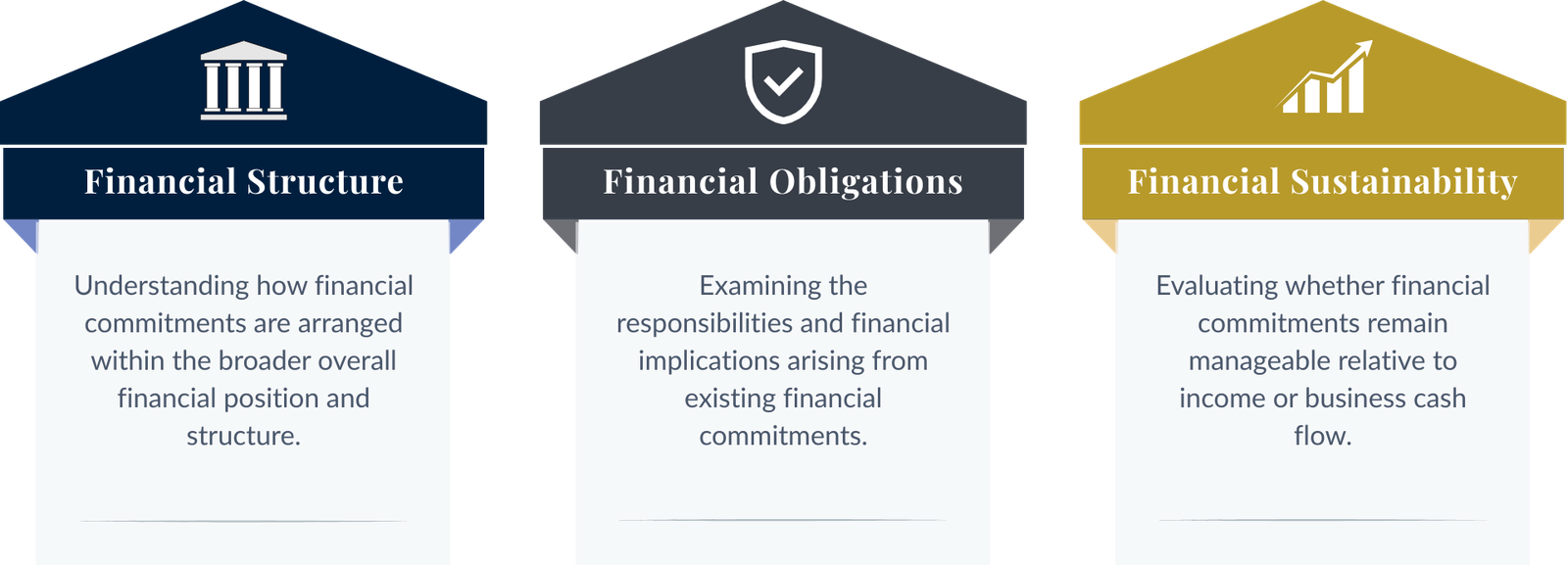
This perspective focuses on understanding how financial commitments are arranged within the overall financial position. Commitments such as housing loans, business financing, and credit facilities collectively shape the financial structure that influences financial flexibility and decision-making capacity.
This perspective examines the responsibilities and financial implications arising from existing financial commitments. Understanding these obligations provides clearer insight into repayment responsibilities, financial risks, and the potential impact on financial stability.
This perspective considers whether financial commitments remain manageable relative to income or business cash flow over time. Evaluating sustainability helps individuals and business owners better understand how financial commitments may influence long-term financial stability.
A STRATEGIC FINANCIAL ADVISORY METHODOLOGY
The MAGNUS Model
The MAGNUS Model offers a structured approach to evaluating financial commitments and guiding businesses towards stronger financial positioning and sustainability.
We conduct a comprehensive evaluation of your financial profile, credit capacity, and existing obligations to establish a clear understanding of your current position and identify opportunities for structured financial improvement.
Alignment
_____________ Corporate Financial Positioning
Your financial structure is strategically aligned with institutional evaluation standards, ensuring your financial profile demonstrates clarity, credibility, and consistency with the expectations of professional financial institutions.
Gearing
_____________ Capital Structure Optimization
We assess and optimize your capital structure by balancing financing and equity components, enabling sustainable leverage that supports business growth while maintaining prudent financial stability.
Navigation
_____________ Debt Structure Management
Through structured advisory, we guide businesses in managing multiple financial obligations, ensuring repayment structures remain sustainable, well-organized, and supportive of long-term financial health.
Effective financing extends beyond access to capital. We advise on the strategic utilization of funds to strengthen working capital management and maintain sustainable liquidity throughout business cycles.
Safeguard
_____________ Financial Risk & Asset Protection
The final layer focuses on financial risk governance, ensuring appropriate safeguards are established to manage liabilities responsibly while protecting both business continuity and personal financial interests.
Advisory Engagement
The Structured Engagement Process
Our advisory engagements follow a structured process designed to provide clarity, disciplined analysis, and practical financial guidance for business owners.
Advisory support for executing restructuring strategies.
Professional Credentials
Experience and Expertise You Can Rely On
Our advisory approach is supported by professional qualifications, industry experience, and a specialised focus on SME financial structuring.
Qualified Financial Planner
_____________
Registered Financial Planner (RFP) with the Malaysian Financial Planning Council (MFPC), upholding professional standards in financial advisory and responsible guidance.
12+ Years of Experience
_____________
Over a decade of experience in banking and finance, supporting businesses in navigating financial commitments and capital decisions and strategic capital management decisions.
SME Structuring Advisory
_____________
Expertise in structuring business financing and capital arrangements to balance debt obligations, support healthy cash flow, and maintain long-term financial sustainability.
Take the First Step Towards Financial Clarity
Discuss your financial position with us and explore practical strategies for responsible financial structuring.